

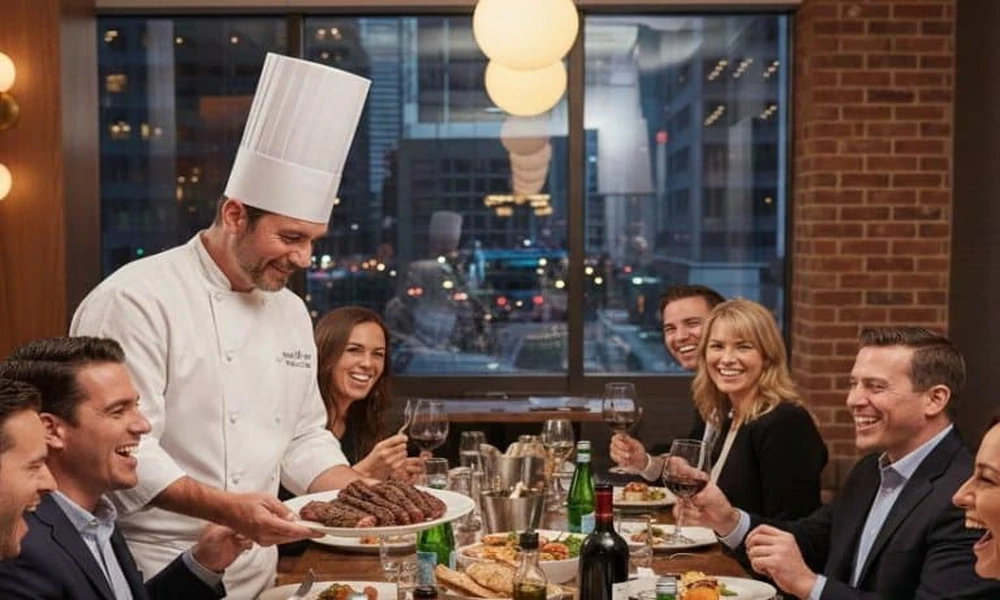
Most company dinners disappear from memory inside a week. You book a private room, people eat, someone makes an awkward toast, and everyone files out by 8:30. That’s not a team event. That’s a catered meeting.
Planning one that people genuinely remember takes about four deliberate decisions. Get those right and a dinner becomes the kind of thing new hires hear about before they ever attend one. Miss them and you’ve spent a real budget on something forgettable. Here’s what actually separates the two.
Why Shared Meals Carry More Weight Than You Think
This is not a soft-skills argument. The research here is hard and it keeps landing in the same place.
The 2025 World Happiness Report, drawing on American Time Use Survey data, found that roughly 1 in 4 Americans reported eating all of their meals alone the previous day, an increase of 53% since 2003, with dining alone becoming more prevalent across every age group. That trend reaches right into your office. People are eating lunch at their desks, ordering DoorDash at their apartments, and wrapping up the day without sharing a single meal with another person. A company dinner, done well, pushes back against that.
Americans who dine alone report life evaluations that are, on average, 0.5 points lower on wellbeing scales than those who dine with others, according to the same World Happiness Report analysis of American Time Use Survey data (2025). Half a point sounds small until you realize that gap is statistically comparable to the difference between having a close friend and not having one.
A well-planned team dinner is not a perk. It’s a structural intervention against one of the most measurable drags on human wellbeing in modern life. Frame it that way internally and suddenly getting budget approval is a lot easier.
The 3-V Framework for Picking the Right Venue
Every venue decision comes down to three variables, and most planners only consciously think about one of them.
Vibe. The atmosphere sets the emotional register for everything that follows. A white-tablecloth venue signals formality, which is fine for client entertainment but creates stiffness inside a team. If the goal is actual conversation and bonding, lean toward a setting with warmth: exposed wood, ambient lighting, and menus people recognize and enjoy. Casual confidence beats polished distance every time.
Volume. Not the noise level (though that matters). Volume means the actual size of your group and whether the space is built for it. A party of 12 around a regular dining table is a fundamentally different animal from 12 people in a room designed for 50. The best group dining spaces create what hospitality designers call “contained intimacy,” where the room neither dwarfs nor crowds your party.
Veto power. Does anyone at the table have a dietary restriction, a strong food preference, or a cultural reason to avoid certain proteins? A menu built around one protein category, say a full smokehouse format, is perfect when everyone’s on board. Check before you book, not after. One person quietly not eating ruins the social physics of the table.
Run those three variables before you shortlist venues and you’ll cut your decision time in half.
What the Private Dining Format Actually Gets You
Here’s a concrete scenario: a 12-person sales team celebrating a strong quarter close. They’re spread across three time zones, some haven’t met in person since the last offsite, and the manager wants the night to actually feel like a celebration rather than an obligation.
A private dining setup fixes most of the structural problems. No competing conversations from adjacent tables. No waiting for a server who’s covering seven other parties. No moment where half the group can’t hear the other half because someone seated a DJ next to your booth. The room is yours, the timeline is yours, and the energy stays in the room.
That’s the case for dedicated private event spaces over general reservations for groups. Options like private dining at Bourbon Brothers offer exactly this kind of contained, dedicated experience for groups who want the atmosphere of a full-service smokehouse without competing for attention with the rest of the dining room.
The format works for client appreciation dinners, department milestones, onboarding dinners for new hires, and end-of-year celebrations. The occasion shapes the tone; the format makes it executable.
Planning Checklist: Eight Decisions to Lock In Before You Book
- Headcount with a buffer. Confirm your number, then add 10% for last-minute additions. Private rooms are easier to fill than to expand.
- Dietary needs. One email to the group, three days out. Collect responses before the reservation.
- Food and beverage minimum. Most private rooms carry one. Know it before you sign so it doesn’t become a surprise on the invoice.
- Start time. A 6:30 p.m. start works better than 7:00 for groups with early-rising executives. Build in 15 minutes of arrival buffer.
- Program length. Two hours is the sweet spot for a dinner with no formal program. Three hours if there’s a toast, an award, or a presentation.
- Seating arrangement. Round or U-shaped tables encourage cross-group conversation. Long rectangular tables create two separate conversations, one per half.
- AV needs. If someone’s presenting, confirm screen and microphone availability before the day of, not during setup.
- Point of contact on site. Get a name and a direct number for the venue’s event coordinator. Group dinners move fast and you’ll need someone who can make decisions in real time.
What the Broader Industry Data Shows About In-Person Gatherings
The pull back toward in-person dining is real and measurable. A 2024 national survey by US Foods found that 55% of consumers said they prefer dining out at restaurants rather than ordering takeout or delivery, a sharp increase from the 43% who favored dining out in 2023. People are making an active choice to be in rooms together again, and the restaurant industry is responding to that demand.
| Event Type | Ideal Group Size | Ideal Venue Format | Typical Duration |
|---|---|---|---|
| Department milestone dinner | 8 to 20 | Private dining room | 2 to 2.5 hours |
| Client appreciation dinner | 4 to 12 | Semi-private or full private | 2 to 3 hours |
| End-of-year team celebration | 20 to 60 | Full event buyout | 3 to 4 hours |
| New hire onboarding dinner | 6 to 15 | Private dining room | 1.5 to 2 hours |
The U.S. Bureau of Labor Statistics classifies private event catering and full-service restaurants as distinct subsectors of the food services industry, which tells you something useful: the infrastructure behind a great private dinner is genuinely different from what’s running a standard restaurant floor. Venues that specialize in private events have built separate staffing models, reservation systems, and service protocols around that specific kind of hospitality.
“The number of shared meals explains as much variation in wellbeing as some key socioeconomic indicators, such as income or unemployment.” The 2025 World Happiness Report, drawing on Gallup survey data across 142 countries, placed communal dining in the same tier of human importance as financial stability.
That’s the framing worth keeping in your back pocket when someone on the finance team asks why you’re spending real money on a dinner instead of just doing a Zoom happy hour.
The Details That Separate Memorable From Mediocre
Three finishing touches that cost almost nothing but change how the night feels:
- A printed or handwritten menu on the table. It sounds small. People pick it up, read it, and start talking about the food before it arrives. Conversation begins before the first drink.
- A clear “this is when we end” signal at the start. Announcing the plan creates comfort. People stop watching the clock and start being present.
- One planned moment, not a speech. A short round of “one thing you’re proud of from this quarter” around the table takes four minutes and produces the kind of shared memory that sticks.
The venue does the heavy lifting on food and atmosphere. Your job is the three things above and the eight booking decisions locked in ahead of time. Do both and you’ve got a dinner people reference in conversations a year later. Skip either and you’ve got a really good meal that nobody mentions by Tuesday.
What’s the last team dinner your group still talks about? Odds are someone made at least one of these decisions deliberately. Start there.
