

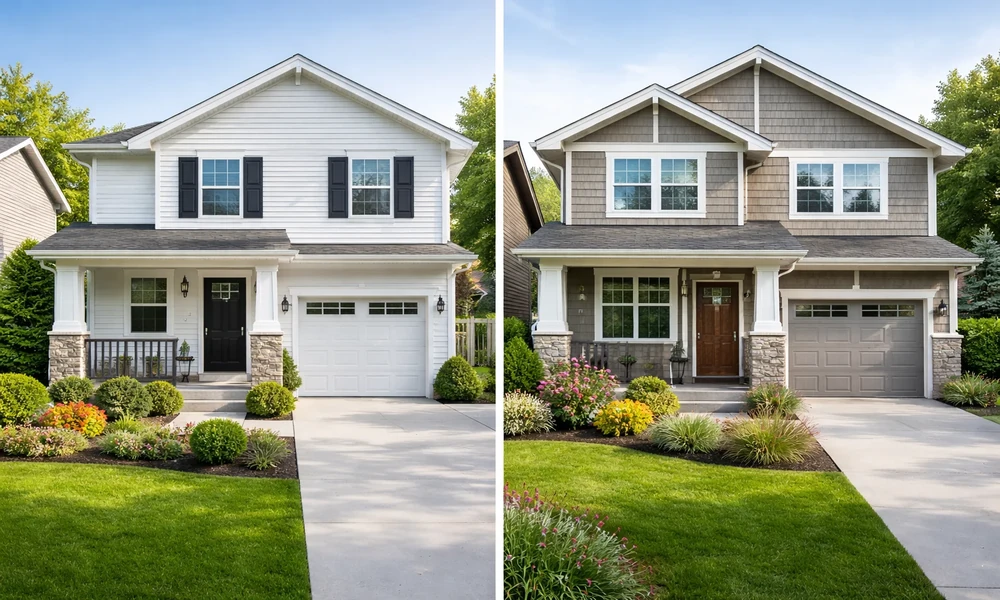
Ninety-seven percent back at resale. That’s not a typo, and it’s not for a kitchen gut renovation or a luxury bathroom remodel. That number belongs to one of the least glamorous home upgrades you can make: replacing your siding. If you’re standing between two bids right now, one for vinyl and one for fiber cement, the good news is that both of them are genuinely strong investments. The harder truth is that they’re strong in different ways, for different homeowners, in different situations. Here’s how to figure out which one belongs on your house.
The Numbers That Actually Matter
Before you pick a material based on what a salesperson told you, look at what the data says. According to the Journal of Light Construction’s 2025 Cost vs. Value report, replacing vinyl siding recoups 97 percent of its cost at resale, while installing fiber cement siding recoups 114 percent of its cost , as reported by Consumer Reports.
That 114 percent figure is worth sitting with. Very few home improvements return more than you spent. Fiber cement siding is one of a small group that does, and that’s not a regional quirk. Those are national averages across all U.S. markets.
The average vinyl job costs nearly $18,000, and the average fiber cement project tops $21,000, according to JLC. So the gap in upfront cost is real, roughly $3,000 to $4,000 on a typical single-family home. Whether that gap matters to you depends entirely on what you’re optimizing for.
| Factor | Vinyl Siding | Fiber Cement Siding |
|---|---|---|
| Avg. installed cost (national) | ~$18,000 | ~$21,000 |
| 2025 Cost vs. Value ROI | 97% | 114% |
| Expected lifespan | 20 to 30 years | 50+ years |
| Maintenance required | Low (wash only) | Moderate (repaint every 10 to 15 years) |
| Fire resistance | Lower | Higher (non-combustible) |
| Appearance ceiling | Good, improving | Premium, wood-like texture |
Source: JLC 2025 Cost vs. Value Report, as cited by Consumer Reports (2025).
The Pay-Now vs. Pay-Later Framework
Here’s the way I’d frame this decision: vinyl is a pay-later material and fiber cement is a pay-now material. Vinyl costs less upfront, requires almost no maintenance, and still returns nearly every dollar at resale. But it’ll need replacing again in 20 to 30 years. Fiber cement costs more today, demands a repaint cycle every decade or so, but it may genuinely outlast your time in the home. You’re paying now to stop paying later.
Neither of those profiles is wrong. They’re just suited to different situations.
“Of the top 10 projects with the highest ROI, eight are exterior replacement projects,” notes the JLC 2025 Cost vs. Value analysis, with fiber cement siding ranking fourth on the national list and vinyl siding at sixth. Exterior work is where the real payback lives.
The two siding projects have both risen two notches on the national averages list, according to the JLC 2025 report, with eight of the top 10 highest-ROI projects being exterior replacements. That’s not a coincidence. Buyers form their opinion before they walk through the front door, and a tired, bubbling exterior undercuts every dollar you spent on the kitchen inside.
What Your Climate Should Tell You
Material performance isn’t purely a spreadsheet question. Where your home sits physically changes the math.
In the Southeast, including Georgia and the broader Atlanta metro area, you’re dealing with humidity, heat cycles, and the occasional severe thunderstorm. Vinyl handles moisture well and won’t rot, but it can warp and fade under prolonged UV exposure if you’re choosing a lower-grade product. Fiber cement handles those same conditions without deforming. It also carries a non-combustible rating, which matters increasingly in areas where wildfire risk is part of the regional conversation, even if it’s not the first thing Atlanta homeowners think about.
If you’re planning a full exterior refresh and want Atlanta siding installation that accounts for local climate, contractor experience with the specific material you choose matters as much as the material itself. Fiber cement installed poorly is worse than vinyl installed well. That’s not a knock on either product; it’s a reminder that labor quality is half the equation.
The Honest Case for Vinyl
Vinyl gets unfairly dismissed in premium renovation circles. It’s genuinely excellent for a large category of homeowners: people who want a clean, low-maintenance exterior, aren’t planning to sell for 10 or more years, and don’t want to think about a repaint schedule. Modern vinyl profiles have improved significantly. Thicker gauges, insulated backing options, and more convincing textures make today’s vinyl a different product than what was going up in the 1980s.
If you’re on a tighter renovation budget and need to address failing siding now, vinyl is not a compromise. It’s a rational, high-ROI choice that virtually no buyer will penalize you for at resale.
The Honest Case for Fiber Cement
Fiber cement is the right material if you want the exterior to look genuinely premium, you’re in a neighborhood where comparable homes have already upgraded to HardiePlank or similar products, or you plan to hold the house for 20-plus years and want to stop thinking about siding entirely.
The repaint requirement is real. Plan for it roughly every 10 to 15 years, depending on your climate exposure. Factor that cost into your total ownership math. When you do, the higher upfront price often levels out, and the ROI advantage at resale tilts things clearly in fiber cement’s favor if selling within the next decade is part of your plan.
A Simple Decision Checklist
Run through these four questions before you commit:
- Are you selling within 5 years? Fiber cement’s 114% ROI makes it the stronger play. The premium look supports a higher asking price.
- Is your budget tight right now? Vinyl at ~$18,000 average and 97% ROI is not a consolation prize. Go vinyl and invest the savings elsewhere.
- Do you hate maintenance tasks? Vinyl wins. Wash it occasionally, done. Fiber cement needs periodic repainting, and skipping that will cost you both aesthetically and structurally.
- Are neighboring homes using fiber cement? Buyer expectations are set by comparable properties on your street. If fiber cement is the neighborhood standard, matching it protects your value. If vinyl is the norm, vinyl fits.
That last point is underrated. Appraisers and buyers benchmark against comps. Installing fiber cement in a block of vinyl homes might not return the full 114% locally, even if the national average supports it. Know your specific market before you sign a contract.
Getting the Install Right
No siding material performs above its installation quality. Both vinyl and fiber cement depend on proper flashing, moisture barriers, and trim work. The JLC 2025 Cost vs. Value report , available at JLC Online, tracks these projects at the national level, but local execution is what actually shows up on your home and in your sale price.
Ask any contractor you’re considering for examples of both material types they’ve installed locally. Ask specifically how they handle the transition points: around windows, at roof lines, and at corners. Those details separate a 20-year installation from one that starts failing in seven.
Both fiber cement and vinyl are proven, high-returning investments. One costs more now. One costs more later. Pick the one that fits your timeline, your neighborhood, and your tolerance for maintenance, and you’ll come out ahead either way. The question was never which material is better in the abstract. It’s which material is better for your specific house, in your specific market, right now.
