

Your furnace picked the worst possible night to quit, and it always will. Mine did it on a January evening at 11 degrees below zero, which is the exact temperature where “we’ll get to you tomorrow” stops sounding like a plan.
Here’s the part that stings: that breakdown was preventable. Furnaces rarely die without warning. They cough, they hesitate, they run a little longer than they should, and most of us ignore every signal because the house still feels warm. If you want to skip that whole experience, schedule a seasonal furnace tune-up in Fargo before the first hard freeze, not after the first cold snap.
This is not about selling you a service plan you don’t need. It’s about understanding what a tune-up actually does, what it catches, and why the timing matters more up here than it does in a milder climate. You’ll get the mechanics, a timing calendar you can act on, and a short list of things you can check yourself tonight.
Why a tune-up is cheaper than a mid-winter emergency call
Think about the math. A tune-up costs a fraction of an emergency visit, and that’s before you count the motel room, the space heaters that trip your breakers, or the two days of vacation you burn waiting on a part.
But the real gap isn’t price. It’s supply. When a cold snap hits a whole region at once, every HVAC crew in town is slammed at the same time, and parts warehouses run thin. According to the Department of Energy, heating accounts for the largest slice of a typical home’s energy use, which is exactly why so many systems strain at the same moment. You aren’t competing for a technician against your neighbor. You’re competing against your whole zip code.
A fall tune-up sidesteps that entirely. You book in September or October when the calendar is open, the technician isn’t rushed, and any part that needs ordering has weeks to arrive instead of hours.
What a technician actually checks (and what you can check yourself)
A good tune-up isn’t just a wipe-down and a filter swap. It’s a sequence, and the order matters because each step informs the next.
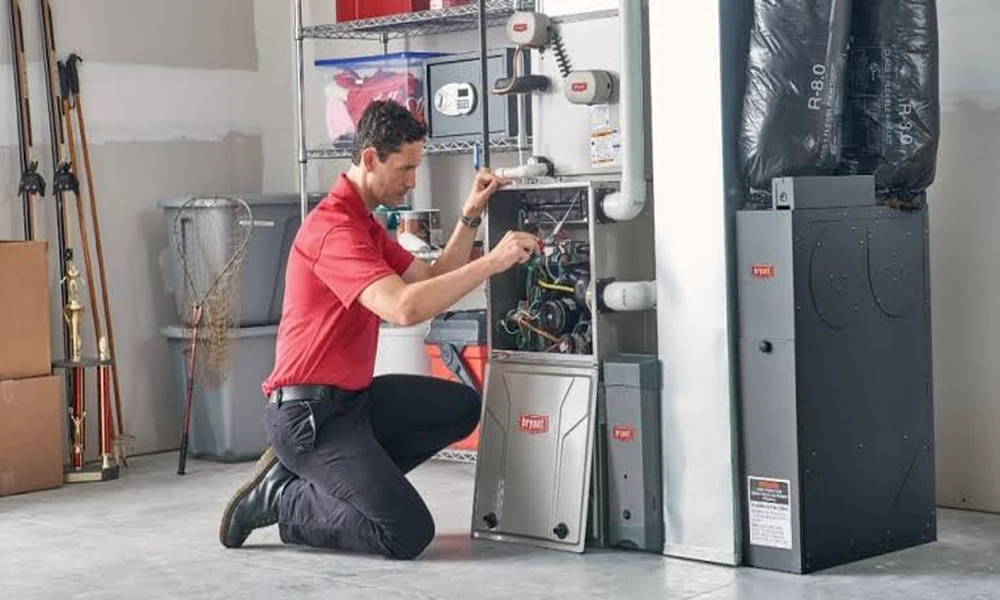
Here’s what a thorough visit covers, and which of these you can handle on your own:
- Filter condition and airflow: You can swap this yourself. A clogged filter forces the blower to work harder and can overheat the heat exchanger over time.
- Burner cleanliness and flame color: A healthy flame burns blue and steady. Yellow or flickering flames point to a combustion problem. Leave this to a pro.
- Heat exchanger inspection: This is the safety-critical step, and it requires a camera and training. Cracks here are a carbon monoxide risk, not a comfort issue.
- Blower motor and belt wear: A worn belt or a dry bearing shows up as noise long before it fails. A technician can catch it early.
- Thermostat calibration and cycling: If your system short-cycles, the thermostat or the control board is usually the culprit.
- Gas line and connection check: Small leaks are invisible and odorless until they aren’t. This one is strictly professional territory.
My honest take: do the filter yourself, and let a technician handle everything past the panel. The heat exchanger alone justifies the visit. You cannot see a hairline crack from the outside, and no amount of YouTube research changes that.
When should you book it in Fargo?
The short answer is late September through mid-October. The longer answer has some texture to it.
Furnaces sit idle all summer, which is when small problems quietly get worse. Dust settles into the burners. Rubber belts dry out. A pilot or igniter that worked fine in April may not fire on the first cold morning in October, and you’ll find out at 6 a.m. on a school day.
Booking in early fall also puts you ahead of the panic window. The first sustained freeze in this region usually arrives well before the calendar says winter, and that first cold snap is when everyone calls at once. A September appointment means you’re on the schedule before the rush, not waiting behind it.
If you missed the fall window, don’t skip the whole year out of spite. A mid-winter tune-up still catches problems, and a spring visit is a reasonable second option for systems that ran hard all season.
What separates a real tune-up from a quick glance
Not every tune-up is equal, and you should know the difference before you book. A rushed visit takes twenty minutes. A real one takes an hour or more, and the technician should walk you through what they found.
Ask these three questions when you call:
- Does the visit include a heat exchanger inspection with a camera?
- Will I get a written report of the readings, or just a verbal “looks good”?
- What’s covered if something fails within thirty days of the visit?
If a company can’t answer those plainly, that tells you something. Standards bodies like the National Institute of Standards and Technology exist precisely because measurement and documentation matter in technical work, and the same principle applies to your furnace. Vague assurances are not the same as a recorded combustion reading. I’d rather hire the crew that hands me a sheet of numbers than the one that tells me everything’s fine and heads for the truck.
A short checklist for the night before your appointment
You can make the visit faster and more useful with about ten minutes of prep.
- Clear a path to the furnace and remove anything stored within a few feet of it.
- Note any strange noises, smells, or cold rooms, and write down roughly when they happen.
- Write down the last time the filter was changed, even if it’s a guess.
- List any rooms that never get warm, since that’s often a duct issue the technician should know about.
- Have your thermostat model and settings ready, especially if you use a programmable schedule.
That list does two things. It saves the technician time, and it gives them real information instead of a vague “it’s been acting weird.” Specifics get you a better diagnosis.
The indoor air angle most people miss
There’s a second reason to care about combustion and airflow, and it rarely comes up in the sales pitch. A furnace that burns cleanly is also a furnace that isn’t pushing combustion byproducts into your living space. The Environmental Protection Agency has long flagged indoor air quality as a real health concern, and in a tight, well-sealed house during a Fargo winter, your furnace is the machine controlling that air.
That’s the connection most homeowners never make. You think of the furnace as a comfort appliance. It’s also an air quality appliance, and it only does that job well when the burners, the exchanger, and the airflow are all in order.
What it comes down to
A tune-up won’t make your house warmer than it already is. What it does is protect the thing keeping you warm when everything outside is trying to do the opposite. You get a system that runs when you need it, a smaller chance of a January emergency, and a written record of what’s actually happening behind the panel.
So look at the calendar. If the leaves are turning and your furnace hasn’t been touched since last winter, you already know what to do next. And if you’re staring at a thermostat reading that won’t budge, ask yourself one question: do you want to be the person calling around during a cold snap, or the person who already had it handled?
